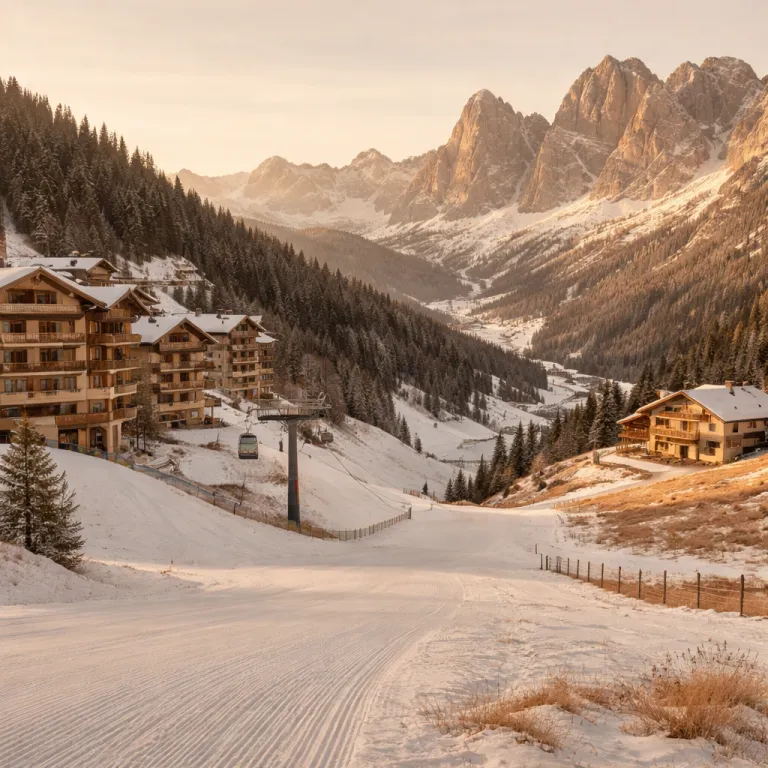
Courchevel 1850 versus the Dolomites: how the premium is eroding
For a decade, any serious Courchevel–Dolomites cost comparison started with a shrug and a surcharge. Courchevel 1850 sat at the top of the Financial Times ski pages as shorthand for the most expensive ski resort in the Alps, while the Italian Dolomites quietly offered lower room rates for skiers who cared more about the mountain than the logo on the hotel key card. That gap is now narrowing fast, and by the coming ski season the data shows that the old assumptions no longer hold.
Historically, a slope side suite in Courchevel 1850 at Cheval Blanc or Les Airelles could command 30 to 50 percent more than an equivalent chalet style junior suite in Cortina d’Ampezzo or Alta Badia, even when the ski area, snow quality and service levels were broadly comparable. The SuperPrime Ski Property research group describes this shift as a textbook case of “price convergence” and notes that “ski resort prices in Courchevel 1850 and the Dolomites are aligning.” When you run a detailed Courchevel–Dolomites price analysis across room types, ski pass costs and on slope spending, you now see parity in several categories and only a modest premium in others.
Lift pricing is the clearest signal that the mountain itself is now valued similarly on both sides of the border. For winter 2024/25, the public tariffs published by Les 3 Vallées and Dolomiti Superski show that a one day adult high season pass sits in the €75–€80 range in both areas, with Courchevel 1850’s local pass and the Dolomites’ flagship ticket now effectively aligned. That means your day’s skiing on perfectly groomed piste and north facing terrain in Savoie costs broadly the same as your time on the dramatic limestone slopes above Cortina d’Ampezzo, so the real Courchevel–Dolomites comparison now shifts to rooms, restaurants and the quality of the overall ski trip.
Room rate parity at the top end: where the numbers now meet
When you strip away the branding and run a like for like Courchevel–Dolomites pricing review, the most interesting movement is at the ultra luxury hotel tier. Courchevel 1850’s inventory is effectively capped, with Cheval Blanc, Les Airelles, Aman Le Mélézin, Le K2 Palace and the incoming Rosewood defining the top of the market, while the Dolomites are adding new hotel ski properties in Cortina d’Ampezzo and Alta Badia that finally match those standards. For a business leisure traveler who wants to book a ski resort with reliable snow, efficient ski lifts and serious restaurants, the choice is no longer as obvious as it once was.
Take a peak week in high season and compare a slope side suite at Cheval Blanc Courchevel, typically quoted in the €4,000–€5,000 per night band, with a projected €3,500–€4,500 rate for a similar suite at the forthcoming Mandarin Oriental Cortina, then benchmark both against an Aman Le Mélézin room and the broader Aman expansion in the Dolomites. Working numbers from regional tourism boards and Alpine hospitality analysts show that the nightly rate gap has shrunk to a band of roughly 10 to 15 percent at equivalent room categories, and in some chalet style suites the Dolomites are now only a few hundred euros below Courchevel 1850. For a reader used to seeing the Trois Vallées ski resorts priced in a different galaxy, that is a structural change rather than a seasonal quirk.
At the upper premium level, where you might previously have booked a south facing junior suite in a five star hotel in Courchevel 1850 with partial slope views, you will find that a similar suite in Cortina d’Ampezzo or Corvara now sits at almost the same nightly rate once you factor in a comparable ski pass and on mountain spending. A focused three or four day comparison between the French and Italian stays shows that any saving in the Dolomites is often reallocated to better F&B, longer spa treatments or a private guide for off piste days, rather than simply reducing the total cost of the ski trip. For a deeper view of how Courchevel’s hierarchy itself is shifting, our analysis of Rosewood Courchevel and where Cheval Blanc, Les Airelles and Le K2 now sit in the local pecking order is essential reading at this detailed Courchevel 1850 hotel hierarchy review.
What your money actually buys: mountain, F&B and time on snow
Once lift tickets cost the same and room rates converge, the meaningful Courchevel–Dolomites comparison becomes a question of value per hour on the mountain. Both Courchevel 1850 and the Dolomites offer extensive ski areas with hundreds of kilometres of piste, but the way you spend your ski pass and your time on the slopes differs subtly. A business leisure traveler extending a work trip into a three day ski break needs to know where each euro buys more snow, more service and more quiet runs.
In Courchevel, the Trois Vallées ski area still wins for sheer interconnected scale, with fast ski lifts, reliable north facing slopes above 1 800 metres and a density of high end restaurant options directly on the piste. You can ski from a hotel in Courchevel 1850 to Méribel or Val Thorens on a single ski pass, and a well planned pass day can cover three valleys without ever repeating a slope, which is ideal when your ski season window is tight. The trade off is that on peak dates the most popular pistes into Courchevel and Méribel can feel busy by mid afternoon, so your day on snow may involve more queue management than you would like.
In the Dolomites, the value equation tilts toward quieter runs, longer lunches and a different kind of luxury on snow. The Dolomiti Superski areas around Cortina d’Ampezzo and Alta Badia offer a mix of north facing and south facing slopes, with the latter delivering long, sun drenched piste cruising that suits a relaxed ski trip where the restaurant is as important as the run. When you compare a three day ski pass and on mountain spending, a careful look at receipts shows that the Dolomites often deliver better F&B quality for the same budget, especially if you prioritise wine lists, local cuisine and time spent at the table rather than in the spa.
For families and mixed ability groups, the Dolomites’ gentle blue pistes and wide open ski areas can feel more forgiving than some of the steeper home runs into Courchevel 1850, which matters when you are balancing client calls with afternoon laps. If you are planning to book a ski resort where grandparents, children and non skiers all feel well served, the Italian resorts around Alta Badia and Val Gardena often offer better value in terms of non ski activities and village atmosphere. Our guide to the best family ski resorts for a refined alpine escape goes deeper into which ski resorts handle this multi generational brief best.
The business leisure decision tree: when Courchevel still wins, and when the Dolomites are smarter
For an executive reader, the real Courchevel–Dolomites trade off is not academic; it is a decision tree for where to host clients, where to decompress after a board meeting and where to bring the family once the deal is signed. Start with your non negotiables: if you need guaranteed ski in access, a specific brand flag and the ability to hold a private dinner in a name restaurant that your guests already know, Courchevel 1850 still justifies a modest premium. Brand stickiness around Cheval Blanc, Les Airelles and the wider LVMH ecosystem has shown unusual pricing power even when local supply looks saturated.
If, however, your priority is maximising value within a fixed budget for a four day ski trip, the Dolomites increasingly look like the smarter allocation of capital. Currency is not the differentiator here, since both France and Italy sit in the euro zone, but labour markets, social tax structures and supply chains mean that Italian operators can often deliver higher service ratios and better F&B for the same nightly rate. When you run a full cost breakdown that includes airport transfers, ski hire, guiding and off piste safety equipment, the Dolomites frequently come out ahead without feeling in any way second tier.
There are still scenarios where Courchevel 1850 is the rational choice for a business leisure ski season, particularly if your guests value the cachet of the Trois Vallées name or need easy access to Geneva and Lyon for short notice meetings. Snow reliability rhetoric also still favours Courchevel’s altitude profile in some climate scenarios, although the Dolomites’ Olympic driven investment in snowmaking and lift infrastructure is the under discussed counter that will reshape the next decade of ski areas across Cortina d’Ampezzo and beyond. For a broader context on how these destinations sit within the wider landscape of high end European ski resorts, our elevated guide to the best European ski resorts for luxury stays maps out where each mountain, resort and hotel now stands.
Key figures behind the Courchevel–Dolomites price convergence
- Average daily lift ticket prices in Courchevel 1850 and in the Dolomites are now reported at roughly the same level for a standard pass day, with winter 2024/25 adult high season rates clustered around €75–€80 according to the latest public tariffs, which marks a break from the historic premium previously charged in Savoie.
- Tourism board data and economic analysts tracking ski resorts across the Alps indicate that the former 30 to 50 percent room rate premium for Courchevel 1850 over equivalent Dolomites properties has narrowed to a band closer to 10 to 15 percent at the ultra luxury tier.
- Market comparison studies using big data for price tracking show that price equalisation between these ski areas is driving increased competition and enhanced value offerings, giving skiers more options at similar price points and encouraging them to compare package deals more rigorously.
- Recent research summarises the structural shift with three core findings: “Price equalization between resorts”, “Increased competition”, and “Enhanced value offerings”, which together explain why more skiers will find comparable value whether they book a hotel in Courchevel 1850 or in the Dolomites.
- In response to the question “Why are ski resort prices converging?” analysts state clearly that “Increased competition and market dynamics.” are the primary drivers, while the answer to “How does this affect skiers?” is that “More options at similar price points.” now exist across both regions.
- When asked “Which resort offers better value?” the current consensus remains that “Depends on individual preferences.”, reinforcing that a nuanced Courchevel–Dolomites assessment must weigh snow reliability, lift systems, F&B and non ski amenities rather than headline room rates alone.